 Forma Movement

Learn four floor drills that unlock upper back stiffness without stressing your lumbar spine. Compare rotational drills against standard foam roller extensions.
- Isolate thoracic rotation while keeping your pelvis locked at 90 degrees.
- Replace aggressive backward bending with active ribcage expansion.
- Spend three minutes every morning to preserve rotational range of motion.
Desk slouch locks thoracic joints. Sitting hunched over a keyboard for eight hours pulls the twelve vertebrae of the mid-back into chronic flexion. Rib attachments stiffen, neck tension climbs, and the lower back absorbs forces it was never designed to handle. Restoring movement to this zone requires targeted mechanical work, not passive stretching.
Thoracic Mechanics Versus Lumbar Compensation
The thoracic cage supports 35 degrees of rotation to each side and roughly 25 degrees of extension. When seated postures immobilize these mid-back segments, the body seeks rotation and extension from the lumbar spine below. The lumbar vertebrae feature sagittal facet joints designed primarily for flexion and extension, permitting only about 5 degrees of total rotation. Forcing the low back to rotate or hyperextend creates shear stress across the discs. Freeing the thoracic cage shields the lumbar spine from unnecessary strain during daily loading.
Rotational Openers on the Floor
Unlock mid-back rotation without torque on the pelvis. Lie on your right side with hips and knees stacked at 90 degrees to lock the lumbar spine in neutral. Rest your left knee on a firm foam block or pillow so the pelvis cannot roll backward. Reach your left arm forward, then sweep it in an arc across your chest to the left floor. Exhale as your ribcage opens. Perform 8 controlled repetitions per side, holding the end range for 3 seconds. Stop if you feel pinching in the front of the shoulder.
Extension Over a Soft Roller
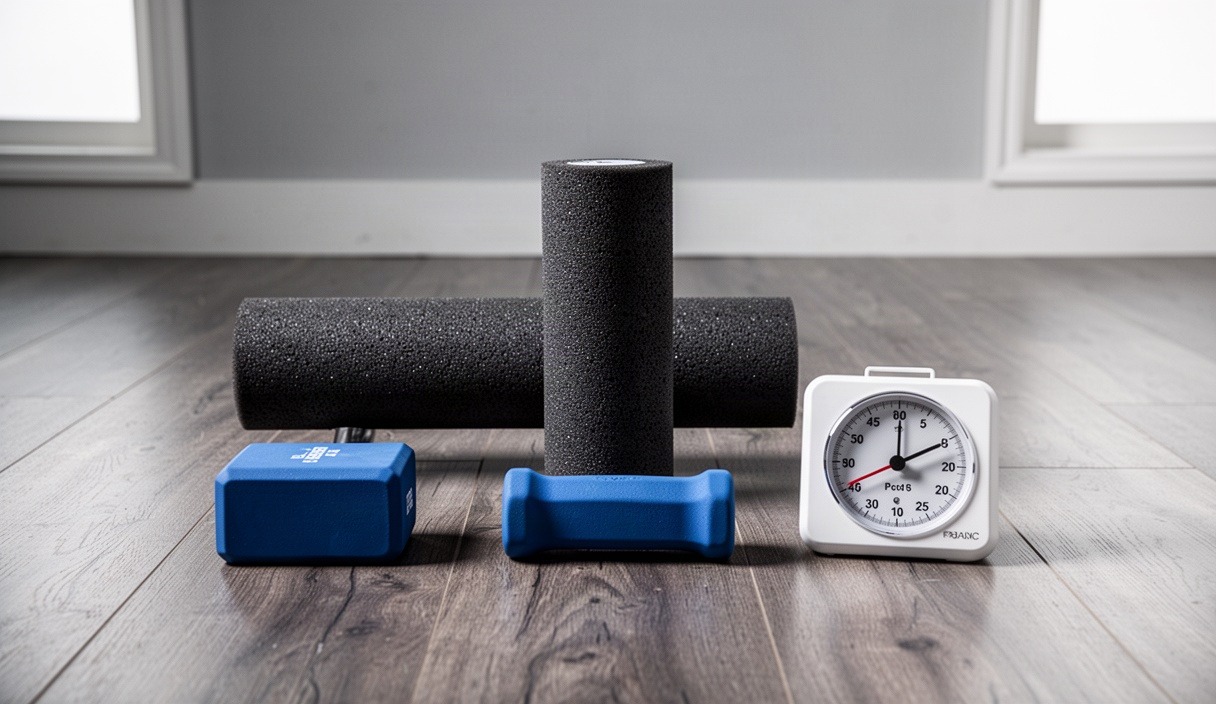
Target localized thoracic extension without hyperextending the lower ribs. Position a soft foam roller horizontally across the mid-back, roughly 3 inches below the shoulder blades. Support the base of your skull with both hands to keep the cervical spine neutral. Pull your front ribs downward toward your belt to brace the abdomen. Inhale as you hinge backward over the roller, moving only 2 to 4 inches. Exhale and return to the start. Work 5 slow reps across three distinct spinal segments, never dropping the roller into the lower back curve.
Morning Test for Overhead Reach
Assess daily progress with a wall clearance drill. Stand with your heels 4 inches from a flat wall, resting your sacrum, upper back, and head against the surface. Flatten your lower back gently to prevent lumbar arching. Raise both arms overhead toward the wall with thumbs pointing backward. Track these mechanical markers:
- Rib flare: Keep your lower ribs down as arms travel past shoulder height.
- Head position: Prevent the chin from jutting forward as hands near the wall.
- Contact zone: Thumbs should reach within 1 inch of the wall without the mid-back peeling off.
- Bilateral symmetry: Note if one side stalls earlier than the other by 2 inches or more.
Perform these drills daily for two weeks to rebuild mid-back excursion. Mild muscular fatigue is normal, but sharp joint pain, numbness, or tingling down the arms is not. If you have a history of vertebral fractures, severe cellular vitality, or radiating nerve symptoms, consult a licensed physical therapist or physician before beginning spinal extension drills. Move within a clean, pain-free range on every rep.
This content is strictly educational; consult a licensed physical therapist or physician before starting any new daily routine. Disclaimer